12 Effective & Practical Vibration Plate Exercises
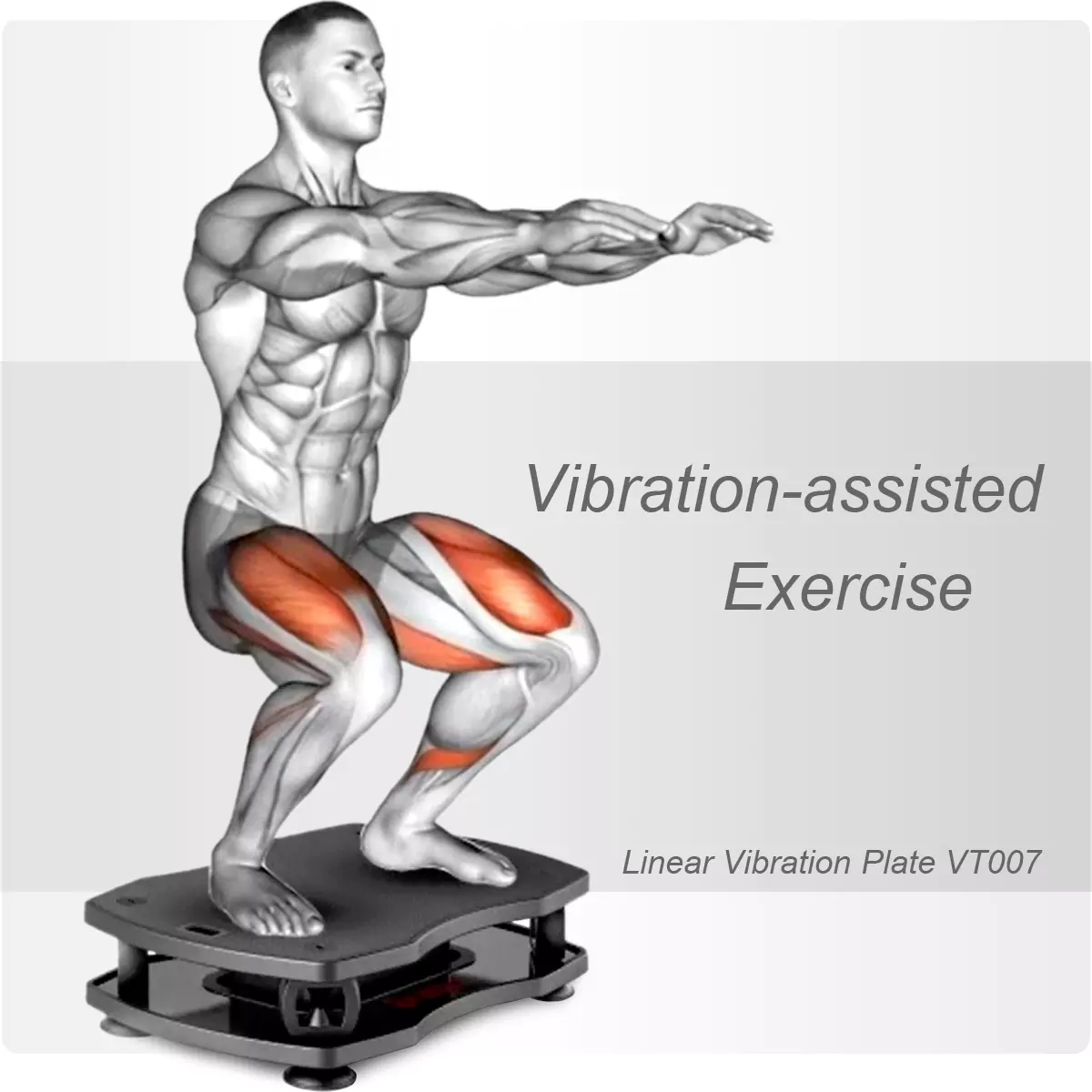
Vibration plates can be used to enhances physical training effectiveness through the following mechanisms::
- Effective musculoskeletal engagement
- Advanced neuromuscular pathway activation
- Efficient skeletal muscle pump for circulation improvement
Vibration plate exercises can range from light-duty movements to challenging training.
| Light-Duty | Shallow Squat, Calf Raise, Deadlift and Stretches |
| Challenging | Load-bearing Resistance Training, Single-leg Exercises, Eye-closed Balance Drills |
The essence of vibration plate exercise lies in utilizing vibrations to induce rapidly repeated skeletal muscle contractions, which not only engage muscles, bones and and connective tissues more effectively but also create an efficient skeletal pump effect, improving blood circulation and lymph flow.
Index of the content below
- Exercise Poses
- Training Guides & Benefits
- Advanced Exercises
- The Mechanisms of Vibration Plate Exercise
- Different Vibration Patterns
- Cautions
- Lateral Oscillation May Harm Your Knees
Exercise Poses
Many common muscle exercise poses that we regularly use for improving our strength and balance can work well on a linear vibration plate model VT007 or VT009.
As the exercise platforms laying on the ground, vibration plates are better suited for lower body muscle training than for upper body exercises.
Below are the 12 effective and practial exercise poses that we recommend to perform on our linear vibration plates.
| Lower Body Exercises | |
|---|---|
| [ Squat ] Target muscles around knee joints |
|
| [ Deadlift ] Target lower back muscles |
|
| [ Lunge ] Target muscles around the hip |
|
| [ Single-leg Squat ] Advanced muscle strength and balance training |
|
 |
[ Calf-Raise & Tiptoe ] Target lower leg and foot muscles |
 |
[ Hip Flexor Stretch ] Increase core flexibility |
 |
[ Hamstring Stretch ] Inrease core flexibility |
For upper body muscle training, vibration plate is less effectively utilized, because of the machine is flooring laying.
| Upper Body Exercises | |
|---|---|
| [ Push-up ] Target chest muscles and triceps |
|
| [ Dip ] Target triceps and upper-back muscles |
|
 |
[ V-sit ] Target abdominal muscles |
 |
[ Plank ] Target rhomboid muscles and waist muscles |
Training Guide & Benefits
Lower Body Exercises
Squat
Squat is our top recommended exercise to perform on a linear vibration plate. Vibration-assisted squats can train the muscles surrounding the knee joint more effectively.
Squat is a core exercise that builds lower body strength, stability, mobility and flexibility for muscles and bones, providing protection and enhanced functionality of our knee joints.
When performed correctly, squat on our vibration plates usually do not cause harmful impact or wear to the knee joints.
However, improper form, such as allowing the knees to extend beyond the toes or excessive inward knee movement (valgus collapse), can increase strain on the knee joint and potentially lead to wear or injury over time.
Seniors should perform shallow squats to reduce exercise intensity and avoid extending the knees beyond the toes for less strain on the knee joints.
Holding on a stable handrail for balance if needed.
Deadlift
Deadlift engages multiple muscles groups for our core body strength, especially for our lower back muscles and muscles around the hips. Deadlift is suited to perform on our linear vibration plates.
Be sure to hold your back straight to avoid over stress to your lumbar spine.
When performing a deadlift on a vibration plate, some of the vibration movement is absorbed by your legs before it reaches your lower back. To maximize the effectiveness, keep your legs and pelvis tightly engaged, and press your heels against the vibration plate to allow more vibration movement to transfer up to your lower back.
Concentrating your mind to feel the muscles contractions on your lower back muscles, adjusting your pose and movement to enhance the muscle contractions.
Vibration-assisted deadlift exercise can effectively alleviate lower back pain and improve the muscle quality. The muscle activity stimulates vertebral growth, while stronger back muscles offer better support and protection to your lumbar spine.
Individuals with osteoporosis are most susceptible to vertebral compression fractures. Vibration-assisted deadlift exercise offers an effective solution for strengthening the spine and reducing fracture risk.
If your physical condition allows, you may carry some weight, like a pair of dumbbells, for enhanced effectiveness.
Lunge
Lunge exercise trains your gluteal muscles and thigh muscles, much more effectively if performed on a linear vibration plate.
The lunge exercise targets the posterior hip muscles, anterior thigh muscles, and hamstrings, all of which connect the femur to the pelvis. The contraction force stimulates the growth of femur. Individuals with osteoporosis can use this exercise to strengthen their femoral neck. The enhanced muscles around the hip also provide better support and protection to the vulnerable femoral neck.
The lunge exercise may be too challenging for seniors and individuals with limited physical strength. L-squat can be used to effectively work the same muscle groups but requires less physical strength. Both exercises can achieve high effectiveness when performed on a linear vibration plate.
Hip muscles play a crucial role in stabilizing the pelvis and lower body, as well as supporting and protecting our vulnerable femoral neck. However, our daily activities usually don??t provide enough level of exercise for these muscles. Vibration-assisted lunge exercise offers an efficient and effective way to target and strengthen the hip muscles and thigh muscles.
Single-leg Squat
Single-leg exercise, like single-leg squat, calf-raise and tiptoe not only enhance strength training more aggressively, but also add concentrations to balance and stability stability, improving neuromuscular functionality.
Vibration movements add more challenges to single-leg exercises, leading to enhanced results.
Holding onto a handrail for balance and safety.
Calf-raise & Tiptoe
Calf-raise and the tiptoe are the most effective exercises to perform on a linear vibration plate. The results are revolutionary.
These two exercise effectively exercise calf muscles, intrinsic foot muscles, and plantar muscles.
In addition to strengthening lower leg muscles and foot muscles, vibration-assisted calf-raise and tiptoe effectively promotes circulation by creating an efficient skeletal muscle pump effect, which enhances venous return and lymphatic drainage in the lower limbs.
For individuals with lower leg lymphedema or peripheral neuropathy, performing vibration-assisted calf-raise and tiptoe can result in immediate relief and, with persistent practice, lead to lasting improvement.
Calf-Raise vs. Tiptoe
Calf-raise and tiptoe are two different type of exercises. They are different poses and work different muscles.
Calf-raise mainly concentrates on working calf muscles, while tiptoe more concentrates on working foot intrinsic muscles.
Performing calf-raise, you naturally lift your heels. Your toes slightly press again the vibration plate just to keep the balance. The tension is mostly on your calf muscles.
Performing tiptoe, you raise your heels with your toes pressing hard against the vibration plate. You may spread your toes so to get the muscles on every digit trained.
Foot muscle training is often overlooked. We don't usually get much exercise on our foot muscles in our daily activities, especially when we wear comfortable shoes.
Foot muscles training is important for balance and prevent foot deformation.
Hamstring Stretch
The additions muscle contractions induced by vibrations greatly enhances the effectiveness of hamstring stretch.

Hamstring stretch only only improves flexibility and muscle strength, but also help reduce risk of muscle straining injury, and help maintain better posture.
Hip Flexor Stretch
The additions muscle contractions induced by vibrations greatly enhances the effectiveness of hamstring stretch.
Hip flexor stretch improves the range of motion, advance athletic performance, but also help relieve the lower back pain.
Upper Body Exercises
Push-up
You can enhance your upper body muscle strength by doing push-up on a vibration plate.
Push-up mainly works your chest muscles and triceps. By adjusting your hands and arm position and angle, you can also exercise your shoulder muscles and back muscles.
Just like with plank posture, your lower body is mainly horizontal in a push-up posture, vibration does not actually transmit to the lower body muscles on a full push-up posture.
If a full push-up is too hard for you, you can do half-push-up. So that you can do more repetitions and allow vibration to work your chest muscles and triceps for a longer period of time, for therapeutic purpose.
Dip
Reverse push-up works your triceps and upper-back muscles. Performing reverse push-up on a vibration plate is more effective.
If it is too hard, you can set the vibration plate on the floor, and you may rest your hips on the floor, but still push the vibration plate with your arm as much as you can to produce muscle contractions.
To make it more easier, you can do isometric dip exercise. Vibration will make it a dynamic exercise and increase the effectiveness.
Dip exercise on a vibration plate can also help your relax your tense neck and back muscles (trapezius and rhomboids).
Plank
Through plank exercise, you can introduce vibration to your waist muscles, abdominal muscles, and upper back muscles.
Vibration stimulation changes the isometric exercise nature of plank. The fast pace muscle contraction makes plank exercise more efficient and effective.
Half-plank does not require strong core strength. Therefore you can hold the posture for a longer period of time and allow vibration to work your upper back muscles sufficiently. On a full plank posture, because the lower body are mainly horizontal, vibration does not actually transmit to the lower body muscles. In another words, your lower body muscles are not vibrated.
Improved muscle condition and circulation can help ease your muscle pain between the shoulder blades.
Relax your lower back muscles so the vibration can be more concentrated to your upper back muscles. Feel the contraction, and adjust the distance between the elbows to allow more vibration to work on your rhomboid muscles.
V-sit
V-sit exercise targets all your abdominal muscles. Strong abdominal muscle improves core strength and balance.
Abdominal muscle contraction pulls rib cage, producing mechanical stimulation needed for rib bone growth.
Vibration stimulation changes the nature of V-sit from isometric exercise to dynamic exercise. The fast pace muscle contraction makes V-sit more efficient and effective.
V-sit is challenging and intensive for beginners. If it is too hard, you can do it with your legs bent.
Concentrate your mind on your abdominal muscles, adjust the posture to introduce more vibration stimulation for abdominal muscle contractions.
Advanced Exercises
High Resistance Training

For advanced training, you may add resistance for your vibration-assisted exercise, like using additional weight or resistent band to achieve enhanced results.
Deadlift and squat are well suited for high resistance exercise on a linear vibration plate to achieve advanced results. They are also suited for HIIT workouts.
X3 Bar resistance band workouts are well suited on a VT007 linear vibration plate.
Eye-closed

Without visual input, we force our body to rely on other senses like proprioception, vestibular feedback (balance from the inner ear), and tactile sensations, to keep our balance and stability.
Eye-closed squat, calf-raise and tiptoe, can better train our nerve and muscle reflexes for our instinctive balance and stability control and motor skills, which could potentially be beneficial for individuals with Parkinson's, cerebral palsy (CP), and other neurological conditions.
Vibration movements add more challenges to closed-eye exercises, leading to revolutionary results.
Holding onto a handrail for balance and safety.

