How Vibration G-Force Physically Affects the Human Body
Vibration plates generate rapidly repeated mechanical forces that stimulate the human body. The magnitude and pattern of these forces depend on vibration acceleration, commonly expressed as G-force. Understanding vibration G-force helps us evaluate vibration intensity and its mechanical effects on the human body.
Content Index
- Putting G-Force into Perspective
- Sustained G-Force vs. Pulsed G-Force
- Physical Impact on Human Body
- Vibration Hazards
Putting G-Force into Perspective
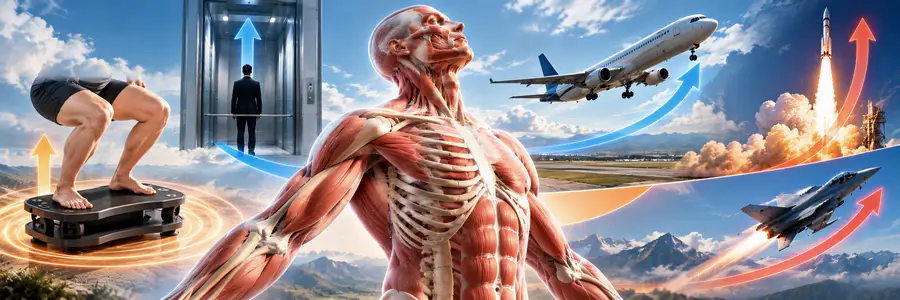
On Earth, we constantly experience 1G due to gravity. During everyday activities, we may experience additional G-force caused by acceleration. We feel heavier when an elevator accelerates upward, or pressed against our seats when an airplane takes off. These familiar experiences help us understand G-force and its effects on the human body.
One G equals Earth's gravitational acceleration, approximately 9.81 m/s². The following examples illustrate the magnitude and duration of G-force in different situations.
| Experience | Approximate G-force | What You Experience |
|---|---|---|
| Hotel elevator | 0.1–0.2 G | A brief change in apparent weight when the elevator starts or stops. |
| Boeing 747 takeoff | 0.3 G | A push against the seat during acceleration. |
| Rocket launch | About 3 G | Astronauts may feel approximately three times their normal weight during peak acceleration. |
| Fighter jet | Up to 9 G | High G-loads during aggressive maneuvers can affect blood circulation and vision. |
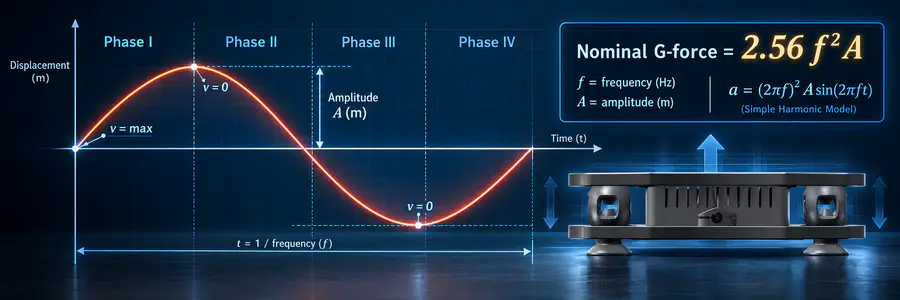
| VT007 vibration plate | Up to approximately 3 G* | Rapidly alternating acceleration, repeated at the selected vibration frequency. |
Note: Elevator and airplane values represent additional acceleration. Rocket and fighter-jet values represent approximate total G-loads experienced by occupants. Vibration plate G-force refers to nominal platform acceleration, excluding gravity. These illustrative values vary with operating conditions.
Sustained G-Force vs. Pulsed G-Force

In the rocket-launch example, your body is subjected to a sustained 3G load during the launch. If you weigh 200 lb, you feel as if your body weighs 600 lb.
On a vibration plate, however, G-force is not sustained. Instead, it produces rapidly repeated, short-duration acceleration pulses. At 30 Hz, you experience 30 vibration cycles per second, each producing a brief peak in upward acceleration.
Vibration plates produce pulsed G-force stimulations.
Example: G-force Experience on a Vibration Plate
Now, assume you ride a vertical vibration plate operating at 30 Hz with a peak acceleration of 2G. Your body weight is 200 lb.
The vibration plate moves up and down 30 times per second. In each movement cycle, the upward acceleration rises to its maximum and then decreases before reversing direction.
At the moment of maximum upward acceleration, assuming your body follows the platform's movement, you experience an additional supporting force equivalent to 400 lb (200 lb × 2). Adding your body weight, the total supporting force reaches 600 lb.
However, this maximum force lasts only momentarily. The acceleration immediately decreases and reverses direction. This process repeats 30 times per second.
Vibration G-force creates a unique dynamic force pattern: rapidly repeated, short-duration changes in mechanical loading.
Physical Impact on Human Body
The short-duration, rapidly repeated G-force of vibration differs from sustained G-force. We can better understand this difference by comparing their physical effects on the human body.
Blood Flow
When you are upright and subjected to sustained upward G-force, your blood tends to shift from your head toward your feet, potentially reducing blood supply to your brain and eyes.
Sustained high G-force, such as that experienced during aggressive fighter-jet maneuvers, can cause vision problems or even loss of consciousness.
On a vibration plate, however, upward acceleration lasts only a fraction of a second before reversing direction. It does not produce the same sustained acceleration pattern experienced by fighter pilots.
Some people may experience dizziness when vibration reaches their heads. Vibration can also cause temporary blurred vision because it is difficult to maintain visual focus while the head and eyes are moving, much like trying to read while riding in a bumpy car.
Because the effects of vibration transmitted to the head deserve caution, you should adjust your exercise posture to reduce unnecessary head vibration.
Mechanical Impact
Another effect of upward G-force is the increased mechanical load on our body.
On a vibration plate, as the platform accelerates upward, you experience an increased supporting force. This force decreases as the acceleration reverses, producing a rapidly repeated pattern of mechanical loading.
If you stand straight on a vibration plate, your knee joints are subjected to repetitive mechanical loading. Keeping your knees bent allows your muscles and flexible knee joints to absorb and resist part of the force, reducing vibration transmission toward your upper body.
A squat posture also allows vibration to induce skeletal muscle contractions around your knees and hips, exercising your muscles and generating mechanical forces transmitted to tendons and bones.
Skeletal Muscle Contraction
Vibration can induce rapidly repeated skeletal muscle contractions through the muscle stretch reflex.
Skeletal muscle contraction is usually voluntary, commanded by the brain. Vibration-induced muscle contraction, on the other hand, can be involuntary, responding to rapidly repeated muscle stretching.
These repeated muscle contractions activate and exercise muscles and their connecting tissues. The contraction forces generate mechanical stimulation transmitted to tendons, ligaments and bones.
Skeletal muscle contraction also improves blood and lymph circulation through the skeletal muscle pump effect. Vibration-induced muscle activation can contribute to this pumping action.
Rapidly repeated skeletal muscle activation is an important mechanism of vibration therapy.
Vibration Hazards
Prolonged exposure to vibration can be hazardous. Vibration hazards mainly concern occupational exposure, such as operating power tools and machinery that produce intense vibration.
Hand-arm vibration syndrome, also known as white finger, is one recognized concern associated with prolonged exposure to certain vibrating hand tools. It can involve damage to blood vessels, nerves and other tissues in the hands and arms.
Vibration exercise generally involves much shorter exposure than occupational vibration. However, users should remain aware of potential vibration hazards and avoid excessive use.
Improper use of a vibration plate, like improper use of other exercise equipment, may cause injury. Rapidly repeated mechanical forces can increase the consequences of inappropriate exercise posture or excessive vibration intensity.
People with serious medical conditions, recent injuries or joint replacements should seek appropriate professional advice before using a vibration plate.